Retrospection on the Game Theory
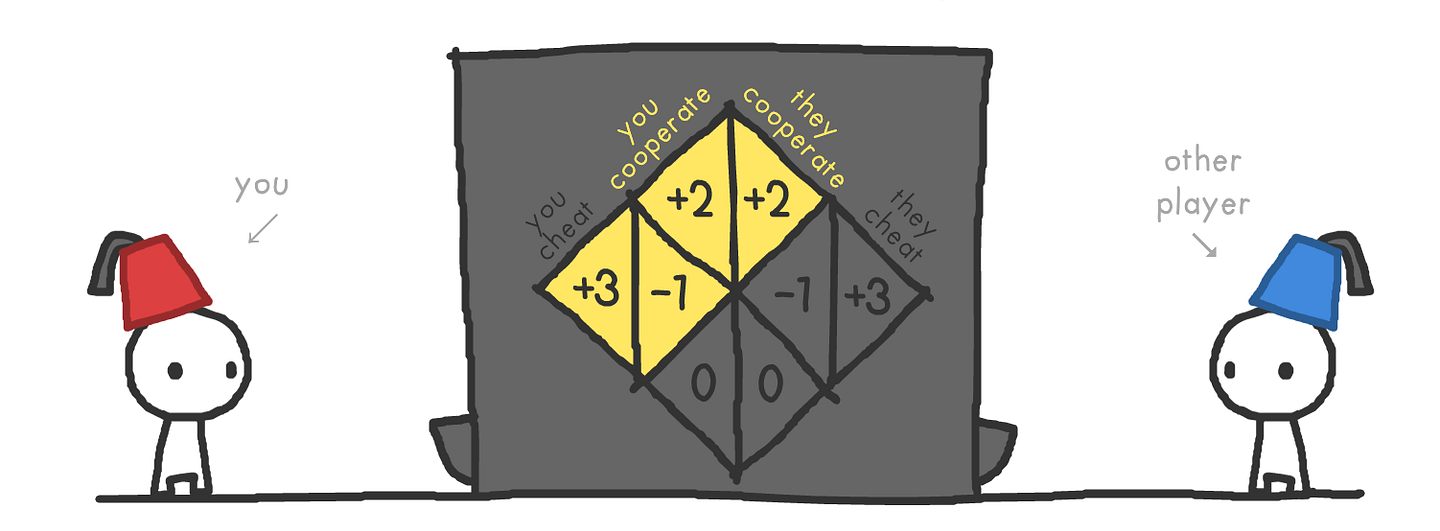
Image from “The Evolution of Trust”
Playing the interactive game “The Evolution of Trust” was a deeply thought-provoking experience, prompting me to examine my own habitual responses in personal and professional interactions.
🤔 The Mirror of Interaction
We often focus on the other player, but what about the “hats” we wear? Our behaviour changes dramatically depending on the situation:
The Constant Kindred: When someone is consistently kind, do I even notice? Do I acknowledge, appreciate, or try to reciprocate that kindness?
The Perpetual Antagonist: When someone acts against me, do I try to communicate and understand their motivation, or do I silently stew in resentment?
The Unpleasant Surprise: When facing a difficult situation, do I take a moment to process and respond thoughtfully, or do I simply react?
I realised that we are not fixed “players,” but rather we adopt roles — sometimes the Copycat, other times the Grudger, and occasionally the Detective. Cultivating a steadfastness in character — putting our minds to action — is key.
📈 Game Theory and the Real World
In an ideal game theory scenario, where players interact repeatedly, strategies like Copycat (Tit-for-Tat) tend to thrive and “win” over time. They begin by cooperating and then simply mirror the opponent’s last move.
However, life is not an ideal scenario.
Limited Chances: We often don’t get multiple chances to evaluate and trust a person. One critical error can lead to a huge loss, and this is what immediately breeds distrust.
The Miscommunication Barrier: Communication today is riddled with potential errors: a toneless email, a laggy video call, or a vague text message. This makes interactions inherently imperfect.
The game confirms that when miscommunication is introduced, the cooperative Copycat strategy quickly evolves into a cycle of mutual cheating.
📉 The Tipping Point of Miscommunication
The results from “The Evolution of Trust” regarding miscommunication are particularly illuminating:
0% Error: The fair Copycat wins.
1% to 9% Error: The slightly more forgiving Copykitten wins (it cooperates even after one slight misstep).
10% to 49% Error: The selfish, unforgiving Always Cheat strategy wins.
50% Error: Nobody wins; chaos reigns.
This is why “miscommunication” is such an interesting barrier to trust: a little bit of it leads to forgiveness, but too much and it leads to widespread distrust! I think our modern media technology, as much as it’s helped us increase communication… has increased our miscommunication much more.
~ Game Theory: The Evolution of Trust
💡 What Do We Learn?
The game theory suggests a clear path forward for building stronger relationships:
Seek Multiple Interactions: Trust is developed through repetition and consistency. We need enough interactions for a reliable pattern of behaviour to emerge.
Embrace Forgiveness: Don’t react to a single miscommunication or misstep. Give the other person the benefit of the doubt, adopting a Copykitten-like strategy.
Find Compromise: Look for win-win outcomes — strategies that seek to maximise both parties’ gains in the long run.